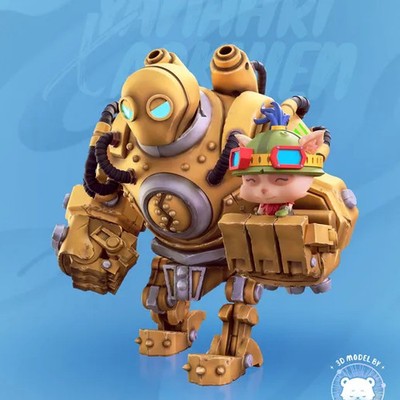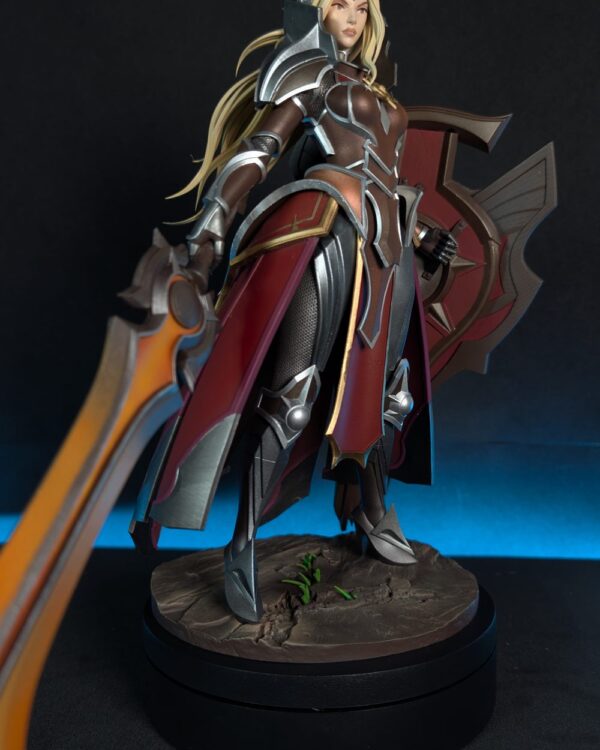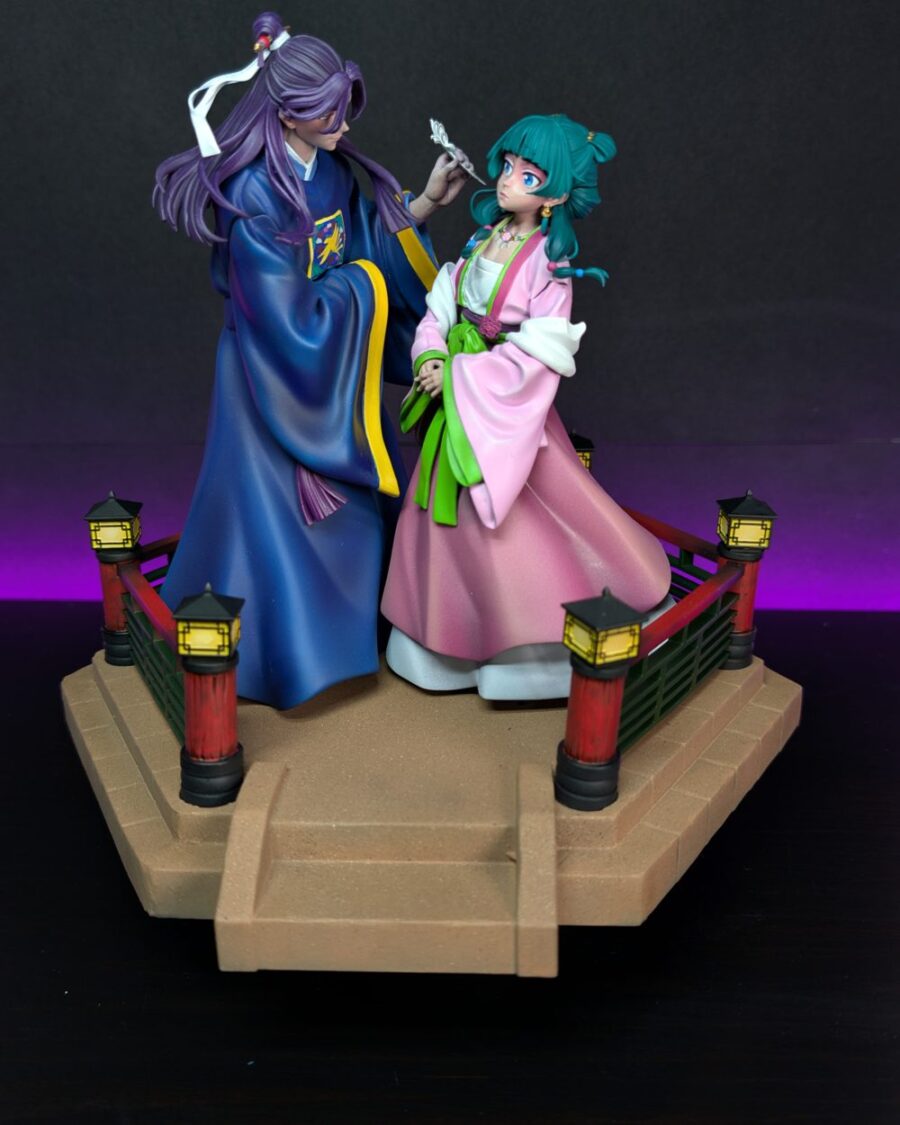
A garage kit is a figure sold as a set of unpainted, unassembled resin parts that you glue, finish and paint yourself. The name comes from the small-run hobby kits that amateur sculptors in Japan once cast in their garages, and today it also covers kits like mine, printed to order in resin from a digital sculpt.
If you keep meeting “GK”, “resin kit” or “unpainted unassembled” in figure listings, this guide is for you. I run a one-woman atelier in Spain where I print garage kits to order, so I will explain the term, how a garage kit differs from a prize figure, a PVC figure and a resin statue, what arrives in the box, sizes, prices and how to get one.
What is a garage kit? Definition and a short history
The term started in Japan in the 1980s. Hobbyists who wanted figures of characters nobody was producing sculpted them by hand, made silicone moulds and cast a small run of copies in polyurethane resin, often in a garage. The name stuck. Because one hobbyist cannot paint and assemble a whole run of figures, the kits were sold raw: a bag of parts, perhaps an instruction sheet, and the understanding that the buyer would do the finishing.
Wonder Festival, the twice-yearly event in Japan, turned that hobby into a culture. Amateur dealers there can apply for a one-day licence to sell a limited run of kits of licensed characters, so a fan sculptor can legally sell a small run of a character no toy company has ever made. That is the heart of the garage kit idea: a figure that exists because one person wanted it to, sold unpainted and unassembled because small runs make factory painting impossible, and finished by the buyer. The materials have changed; the spirit has not.
Garage kit vs prize figure vs scale PVC figure vs resin statue
These four terms get mixed up constantly in listings. The short version: a garage kit is the only one that arrives unpainted and in parts, and the only one you can get for a character nobody has licensed.
| Type | How it is made | Painted | Assembled | Typical scale | Who finishes it |
|---|---|---|---|---|---|
| Garage kit | Small runs, cast in resin or printed to order from a digital sculpt | No, unless you order it painted | No, ships in parts with a base | 1/8, 1/7, 1/6 | You, or a painter you commission |
| Prize figure | Mass produced in PVC for crane games and lotteries in Japan | Yes, factory painted | Yes, or a few pieces that push together | Non-scale, smaller than scale figures | Nobody, it is finished |
| Scale PVC figure | Mass produced in PVC and ABS under licence | Yes, factory painted | Yes | 1/8, 1/7, 1/6 | Nobody, it is finished |
| Resin statue | Cast in polystone or resin in a numbered run | Yes, factory painted | Mostly, a few large parts slot together | 1/6, 1/4 and larger | Nobody, it is finished |
Garage kit vs resin statue is the comparison that confuses people most, because both are resin. The difference is who does the work: a statue is finished by the manufacturer and priced accordingly; a kit gives you the raw sculpt and leaves the finish to you, which is why an unpainted kit costs far less than a painted piece of the same size. Garage kit vs prize figure is simpler: a prize figure is a finished toy; a garage kit is a project, or a commission if you want the finished look.
What arrives in the box from a 3D-printed garage kit today
Classic garage kits were cast in moulds. Many new kits, including every kit I sell, are printed in photopolymer resin from a digital sculpt. 3D printed garage kit vs cast resin garage kit is a fair question. Casting leaves mould seam lines, the occasional air bubble and a skin of excess resin called flash that you trim away. Printing leaves no seams and no flash, but the part comes off the printer held by thin support struts, and at low resolution you can see layer lines. At 16K, which is what I print at, the layer lines are very fine, and a coat of primer covers what remains on most surfaces.
When you open one of my boxes you find the figure in parts: body, head, arms, hair or cape, weapon or accessory, and a base. Each part has had its supports removed, has been washed, UV-cured and hand-cleaned, and I test-fit the pieces before packing. Larger parts are hollowed where it makes sense, and transparent parts (magic effects, water, glass) are printed in clear resin. You need super glue (cyanoacrylate) to assemble it, and primer and paint only if you want to paint it.
Is a garage kit hard to build? A printed kit is easier than the cast kits of the past: no seams to sand, no flash to trim, and the parts usually meet on pegs or flat mating surfaces designed into the sculpt. A typical build is straightforward: dry-fit, glue the large parts first, then the small ones, and let it set. Any remaining support marks come off with a fine sanding sponge. I walk through it in my guide to assembling a resin garage kit.
What I do at the atelier
Every piece is printed fresh when you order it, on an Elegoo Saturn 4 Ultra at 16K resolution, in grey photopolymer resin. I do not keep stock. After printing I remove the supports by hand, wash the parts, cure them under UV, clean up the support marks I can reach and dry-fit the whole figure. If something is not right it goes back to the printer. I inspect every print before it ships, and if a defect gets past me I reprint and reship free when you report it with photos within 48 hours. The full process is on The Atelier page.
Who buys garage kits, and do garage kits come painted?
Two kinds of people, mostly. The first is the kit builder. You paint miniatures or models already, and a garage kit is a bigger canvas: a 30 cm figure with a face to shade and a cape to blend. You want clean parts, good fit and a character you cannot get anywhere else. My guide to painting resin figures picks up where this one ends.
The second is the display collector. You want the character on your shelf, finished, with no sanding involved. Garage kits serve you too, because the kit is only the starting point: you commission the painting. In the classic hobby that meant finding a painter; here it means choosing the hand-painted finish on the figure page. So, do garage kits come painted? From most sellers, no. From my atelier, you choose: an unpainted kit you finish yourself, or a figure I paint by hand with acrylics, shaded and detailed, in a custom colour scheme on request.
A third group overlaps with both: fans of a character nobody has licensed. Characters such as Penelope Eckhart or Esil Radiru are hard to find as official figures. A fan-art garage kit is often the only way to have that character in physical form, and it is the reason many of my 305 figures exist.
Recasts, bootlegs, and how a print-to-order atelier is different
If you come from the cast-resin world you have a reflex: is this a recast? A recast is a copy made by taking a mould off someone else’s finished kit and casting it again, usually with softer detail, and selling it as the original. A bootleg is the same idea applied to mass-produced figures. Both are theft, and collectors are right to be wary.
What I sell is neither. My figures are fan art: digital sculpts of characters from anime, video games and comics, printed to order in my studio. They are unofficial, not made or endorsed by the rights holders, and the characters belong to their owners. I take no moulds off anyone’s kit, and nothing is mass-produced or warehoused. Every piece is printed fresh for the person who ordered it, which is why dispatch takes weeks rather than a day.
How big is a garage kit? 1/8 and 1/6 scale figure size in cm
Scale is a fraction of life size, so a 1/8 scale figure of a 180 cm character stands about 22 cm, and the same character at 1/6 stands about 30 cm. Pose matters as much as the fraction: a crouching figure is shorter, and a raised sword or a tall base adds height. These are the ranges I work to.
| Scale | Standing height | In inches | Good for |
|---|---|---|---|
| 1/8 | About 22-25 cm | About 8.7-9.8 in | Shelves with limited depth, a first kit, the lower price |
| 1/6 | About 30-35 cm | About 11.8-13.8 in | A centrepiece, painters who want room for detail |
| Dioramas and dynamic poses | Can be larger than the scale suggests | Varies | Check the figure page for the piece |
A 1/8 figure is about the height of a hardback book; a 1/6 figure is closer to a wine bottle. Most of my figures come in both scales, and my figure scale guide goes deeper on 1/8 vs 1/6 and how they compare with 1/7 figures you may already own.
How much does a garage kit cost?
My prices start from the figures below. Complex pieces and dioramas cost more, and the exact price for each finish and scale is on the figure page.
| Finish | 1/8 scale | 1/6 scale | Dispatch |
|---|---|---|---|
| Unpainted kit | From 72 EUR | From 99 EUR | 1-3 weeks |
| Hand-painted | From 380 EUR | From 518 EUR | 3-7 weeks |
Why the gap? Printing is mostly machine time plus cleanup by hand. Painting a 30 cm figure well takes far longer: priming, base colours, shading, detailing, varnish, and drying time between stages. The painted price is mostly my hours. For a specific colour scheme, pose or character, see commissions.
Shipping is tracked worldwide from Spain. On Etsy, Spain and the rest of the EU are free, the UK is 20 EUR, and the USA, Canada and the rest of the world are 40 EUR, with 15 EUR per additional item. Inside the EU there are no customs charges. Outside the EU your country may charge import duties and VAT on arrival, which I cannot control. Details are on the shipping page.
How to buy a garage kit here
My website is a catalogue. Browse the shop, or jump to a franchise such as League of Legends, and open a figure page. There you will find the scales and finishes and a button to the live listing on Etsy or eBay, where you choose your scale and finish and receive tracking when it ships. My storefronts are figureatelier.etsy.com and ebay.com/str/3dfigureatelier. If a figure has no live listing, the page shows Enquire to Order instead, and I set one up for you by email.
A few examples to look at: Akali from League of Legends, Esil Radiru from Solo Leveling, and Penelope Eckhart from Villains Are Destined to Die.
You have 24 hours after ordering to cancel, since printing starts soon after. I have five-star reviews on Etsy, and the returns page spells out the reprint guarantee.
Frequently asked questions about garage kits
What does “garage kit” actually mean?
A garage kit, or GK, is a figure sold as unpainted, unassembled resin parts for the buyer to build and paint. The name comes from the small runs Japanese hobbyists cast at home in the 1980s. Today it also covers 3D-printed kits made to order, which is what I make.
Do garage kits come painted?
Traditionally no: the point is that you finish it. At my atelier you can choose either an unpainted kit or a hand-painted figure. The painted version is finished with acrylics, shaded and detailed, and dispatched in 3-7 weeks instead of 1-3.
Is a 3D-printed garage kit a recast?
No. A recast is a mould taken off someone else’s cast kit. My figures are fan-art digital sculpts printed fresh for each order in my studio in Spain, unofficial and not endorsed by the rights holders.
How tall is a 1/8 scale figure compared with a 1/6?
A 1/8 scale figure stands about 22-25 cm (8.7-9.8 inches) and a 1/6 scale figure about 30-35 cm (11.8-13.8 inches). Pose and base change the final height, so check the figure page.
What glue do I need for a resin garage kit?
Super glue (cyanoacrylate). It bonds printed resin quickly and needs no special tools. Heavy overhanging parts can take a short wire pin, which I explain in the assembly guide.
How long does a garage kit take to arrive?
Unpainted kits are dispatched in 1-3 weeks and hand-painted figures in 3-7 weeks, because every piece is printed and finished to order. Shipping is tracked worldwide from Spain, and free within Spain and the EU on Etsy.
If a character you love has never had a figure, a garage kit is how it gets one. Browse the shop to see the 305 figures I print to order, or tell me about the piece you have in mind on the commissions page.