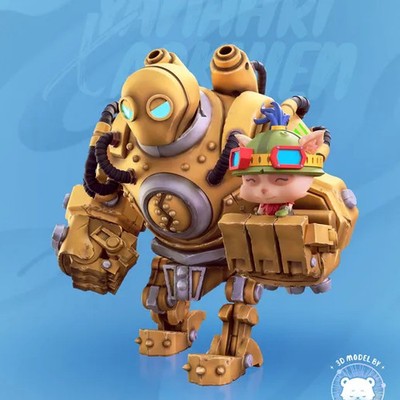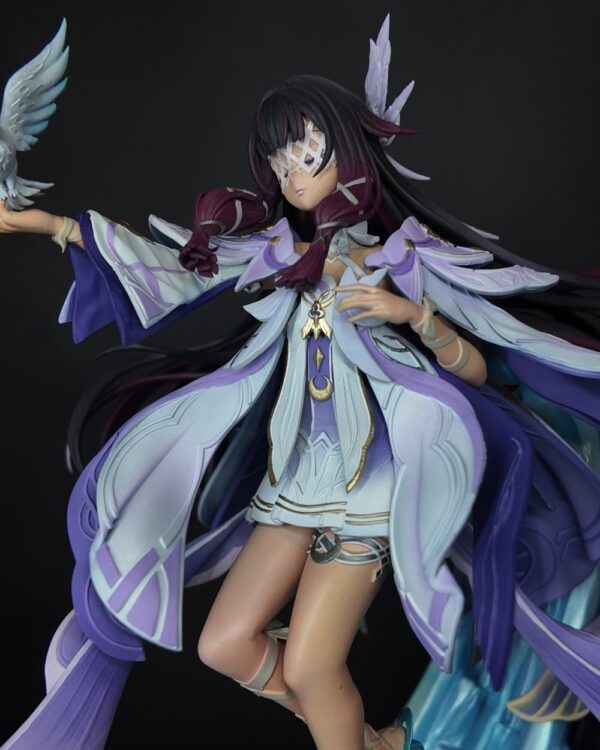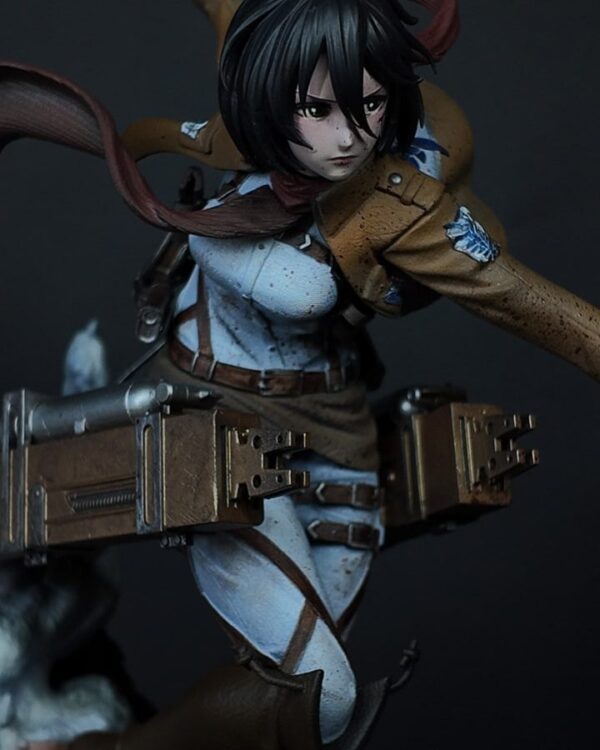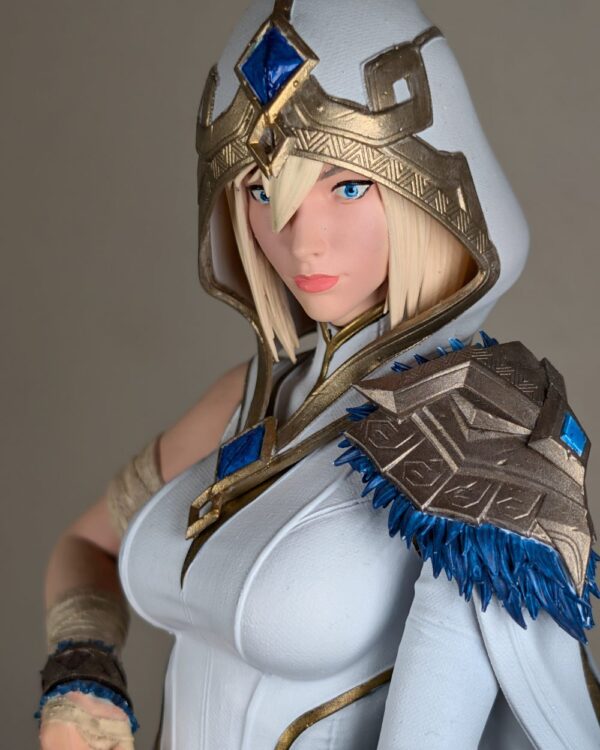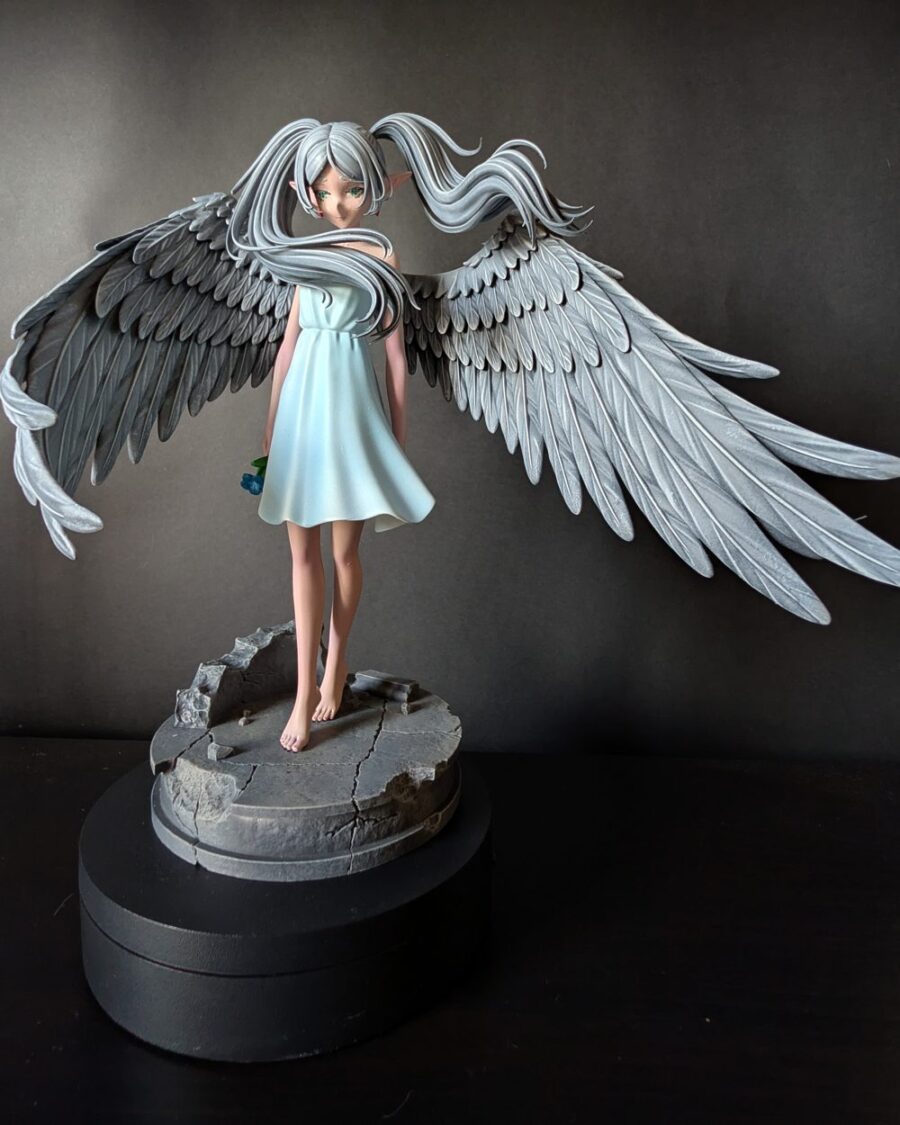
A 1/8 scale figure of a standing adult character is about 21 to 23 cm tall (8 to 9 inches); a 1/6 scale figure of the same character is about 28 to 31 cm (11 to 12 inches). Add a base, a dynamic pose or a big weapon and the real piece gains a few centimetres, which is why the figures I print run a little above those numbers.
What 1/8 and 1/6 actually mean
The scale is a fraction of real life: a 1/8 figure is one eighth of the character’s height, a 1/6 figure is one sixth. The smaller the number under the line, the bigger the figure, so 1/6 is larger than 1/8 and 1/4 is larger still.
The catch is that the fraction describes the character, not the object. A 1.80 m character comes out at 22.5 cm in 1/8 and 30 cm in 1/6; a 1.55 m character comes out at 19 cm and 26 cm. Two figures in the same scale can differ by several centimetres; that is what keeps a collection in proportion.
Scale chart: figure height in cm and inches
Plain arithmetic for a standing adult character between 1.65 m and 1.85 m, head to toe, no base. Use it as a resin figure scale guide for 1/8 vs 1/7 vs 1/6 and the other common sizes.
| Scale | Standing height, cm | Standing height, inches | Where you usually see it |
|---|---|---|---|
| 1/12 | 14 to 15 cm | 5.4 to 6.1 in | Small articulated figures |
| 1/10 | 17 to 19 cm | 6.5 to 7.3 in | Busts and some painted statues |
| 1/8 | 21 to 23 cm | 8.1 to 9.1 in | The classic scale figure; my smaller option |
| 1/7 | 24 to 26 cm | 9.3 to 10.4 in | Very common in factory PVC figures |
| 1/6 | 28 to 31 cm | 10.8 to 12.1 in | Resin statues and garage kits; my larger option |
| 1/4 | 41 to 46 cm | 16.3 to 18.2 in | Large statues that need their own shelf |
The figures I print land a little above this arithmetic, because a sculpt comes with a base and a pose: my 1/8 figures stand about 22 to 25 cm (8.7 to 9.8 inches) and my 1/6 figures about 30 to 35 cm (11.8 to 13.8 inches). Dioramas and dynamic poses can be larger.
Why the pose, the base and the weapon change the footprint
Scale tells you how tall the character would be standing straight. Almost nobody stands straight in a good sculpt.
- Crouching, kneeling and leaning poses are shorter than the scale suggests but wider and deeper. Plan the depth, not just the height.
- Big weapons, wings and capes extend past the body. On a character like Blaidd from Elden Ring, check the photos to see whether the sword or the head sets the tallest point, and remember that a blade angled sideways adds width the height does not show.
- Bases add height and set the footprint. A flat disc adds a centimetre or two; a rock or a ruined pillar can add several. The base is usually the widest part, so it decides the shelf depth you need.
- Two-character dioramas like Maomao and Jinshi are wide before they are tall. Plan the width first.
So a 1/8 diorama can take more shelf than a single 1/6 standing figure: compare the base footprint and the tallest point, not just the scale.
Planning the shelf before you buy
Measure three things: the clear height between shelves, the usable depth from the front edge to the back wall, and the width you will give one piece. Then compare against the figure, not the scale.
| Scale | Clear height to allow | Depth to allow | Notes |
|---|---|---|---|
| 1/8 | At least 28 cm (11 in) | Base width plus 3 cm | Fits most bookcase shelves at normal spacing |
| 1/6 | At least 38 cm (15 in) | Base width plus 5 cm | Often needs one shelf removed |
| Diorama, either scale | Tallest point plus 3 cm | Full base depth plus 5 cm | Check the width too |
Glass cabinets usually have a fixed height between shelves: fine for 1/8, tight for 1/6 on a tall base. Leave a few centimetres of air around each piece so you can lift one out without catching a sword on its neighbour.
1/8 vs 1/6 for painting
If you are buying an unpainted kit to paint yourself, size changes the job more than anything else. A kit comes unpainted unless you order the hand-painted finish, so this choice is yours.
- Bigger is easier to paint. On a 1/6 the eyes, lips and fingers take a normal fine brush. On a 1/8 the same details are about a quarter smaller in every direction. Faces are where beginners struggle, and 1/6 forgives more.
- Bigger shows more. Shading and fabric texture read from across a room at 1/6.
- Bigger costs more. A 1/6 part has more than twice the volume of the same part in 1/8, so it takes more resin and more printer hours. My unpainted kits start at 72 EUR in 1/8 and 99 EUR in 1/6; hand-painted pieces start at 380 EUR in 1/8 and 518 EUR in 1/6, and complex pieces cost more.
- Bigger parts are lighter than you expect. I hollow large parts where it makes sense, so a 1/6 statue is not a solid block.
Either way you will need super glue (cyanoacrylate) to assemble the kit, and most painters sand the support contact points lightly and prime before colour. More on preparing and painting a kit is in my guides.
Which scale I recommend, and why
For painting and for display, I recommend 1/6. It is the scale I would choose for a hand-painted piece: the surfaces are generous, the face is big enough to get right, and a finished piece in the 30 to 35 cm range has real presence on a shelf.
I keep 1/8 because it is the right answer for many people: a collection already in 1/8, a cabinet with fixed shelf spacing, a smaller budget or a first kit to learn on. Both scales are printed from the same sculpt at the same 16K resolution, so you lose nothing in detail by going smaller; you simply have less surface to see it on.
How to judge the size before you buy
Photos lie about size because a tight crop has no reference, so read a figure page in three steps.
- Start with the scale. 1/8 means about 22 to 25 cm for a standing figure, 1/6 about 30 to 35 cm. Dioramas and dynamic poses can be larger.
- Look at the pose in the photos. A crouching or seated figure stands well under the chart for its scale, and a raised sword, long hair or a tall base can put the highest point somewhere other than the head. Check the base for width and depth.
- Ask me if the shelf is tight. Write to me before you order, through the commissions page, and tell me the space you have.
A useful everyday reference: a standard 330 ml drinks can is about 12 cm tall, so a 1/8 figure stands about two cans high and a 1/6 close to three.
What I do at the atelier
I print every kit to order on an Elegoo Saturn 4 Ultra at 16K resolution in grey photopolymer resin, with clear resin for transparent parts. When you choose a scale I resize the sculpt, print it in parts, remove the supports, wash and cure each part, hand-clean the contact points and test-fit the kit before packing. Unpainted kits ship in 1 to 3 weeks and hand-painted pieces in 3 to 7 weeks, tracked, from Spain. The full process is on The Atelier page.
Frequently asked questions
How tall is a 1/6 scale figure in cm?
About 28 to 31 cm head to toe for a standing adult character. My 1/6 figures stand about 30 to 35 cm (roughly 12 to 14 inches) once the base and the pose are counted; dioramas can be larger.
How tall is a 1/8 scale figure?
About 21 to 23 cm for a standing adult, or 8 to 9 inches. My 1/8 figures stand about 22 to 25 cm with the base and the pose.
Is 1/7 bigger than 1/8?
Yes. The smaller the number under the line, the bigger the figure. 1/7 sits between 1/8 and 1/6 at roughly 24 to 26 cm.
Which scale is better for a first painting project?
1/6. The face and hands take a normal fine brush, mistakes are easier to fix, and the result shows from a distance. 1/8 is fine if you already paint miniatures.
Will a 1/6 figure fit a standard glass display cabinet?
Usually, if the clear height between shelves is at least 38 cm for a figure on a tall base. Many cabinets take 1/8 on every shelf and need one shelf removed for a row of 1/6. Measure before you order.
Can I order a scale other than 1/8 or 1/6?
I offer 1/8 and 1/6. For a specific project, such as matching a 1/7 collection, write to me through the commissions page and I will tell you honestly whether it is possible for that sculpt.
Ready to choose? Browse the full catalogue and pick the scale that fits your shelf and your brush. For a hand-painted 1/6 in your own colour scheme, tell me about it on the commissions page.